
Can AI write your commercial proposals?
It can write the parts of a proposal you have already written a hundred times: the context, the description of the work, the method, the assumptions, the next steps. It should not write the price, the scope commitment or the deadline. A model drafts from your own past proposals, a person reads it, adjusts the two paragraphs that are specific to this client, and sends.
Proposals are one of the best cases for AI drafting in a small company, and one of the easiest to get badly wrong. The difference is entirely in where you draw the line between drafting and committing.
01Where the hour actually goes
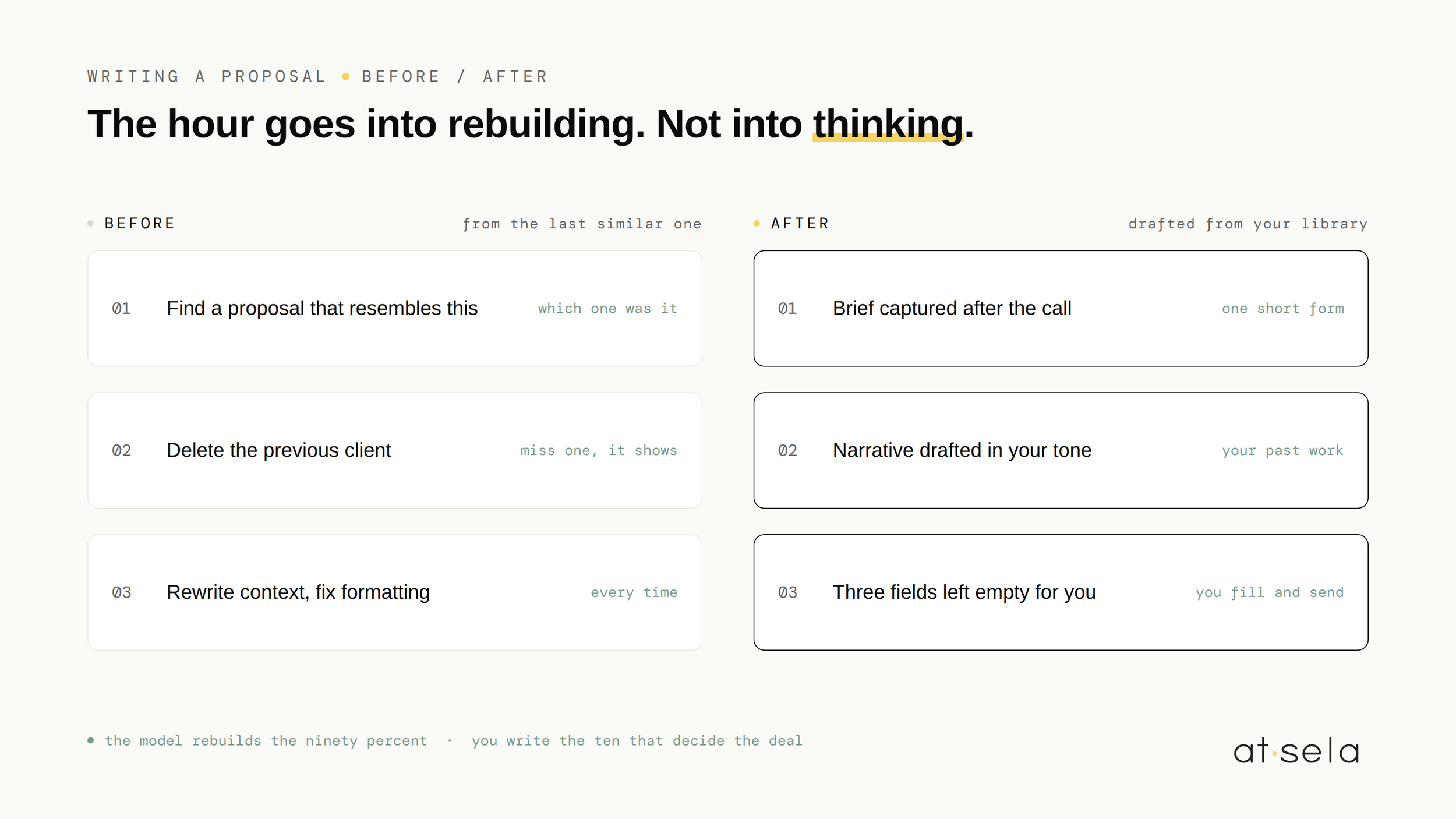
Ask anyone who writes proposals where the time goes and they will say "writing it". Watch the work and you see something else. Finding the last proposal that resembled this one. Copying it. Deleting the parts about the previous client. Rewriting the context paragraph. Rechecking that the method section still matches how you actually work. Reformatting what the copy broke.
Almost none of that is thinking about the client. The two paragraphs that genuinely require judgment, what this client actually needs and what it should cost, take a few minutes. Everything around them is reconstruction, and reconstruction is exactly what a model does well.
02The three things a model must never write
- The price, or anything a client could read as a price
- The scope commitment: what is included, what is excluded, how many rounds
- The deadline, or any date you would be held to
The reason is not caution for its own sake. Those three lines are the ones a client will hold you to, and they are the ones you have to be able to justify. A model produces something plausible, and plausible is the dangerous register: it looks considered, so nobody rereads it. We wrote the general version of this rule in when AI is the wrong tool for the job, and proposals are where it costs the most, because the mistake leaves the building with your signature on it.
In practice these three fields stay empty in the draft, or are filled from a rules table you maintain. Never generated.
03What it drafts well
The assumptions section deserves a word. Most proposals leave it out, and most disputes come from exactly there. A model that has read your past projects is good at surfacing what you implicitly assumed, and writing it down changes the conversation with the client for the better.
04How the build actually works
A form or a short brief captures what came out of the call: who the client is, what they asked for, which of your services it maps to, anything unusual. The scenario picks it up, retrieves the matching blocks from your library of previous proposals, and asks the model to draft the narrative sections in your tone, leaving price, scope commitment and dates untouched.
The draft lands in a document you own, in your template, with the three protected fields visibly empty. You open it, fill those three, rewrite the two paragraphs that matter, and send it yourself. Nothing goes out on its own.
The measure of whether this works is not the time saved on the first draft. It is whether the proposal that reaches the client still sounds like you. If you find yourself rewriting the whole thing every time, the library is the problem, not the model.
05Your templates are the real project
Open them side by side. If the method section is worded five different ways and the assumptions appear in two of them, you do not have a drafting problem. You have a template problem, and a model will reproduce the inconsistency faithfully, five times faster.
This is the unglamorous half of the work and it is where most of the value is. Deciding once what your method section says, what your assumptions always cover, and which three service descriptions you actually sell, is worth more than any scenario. It also takes an afternoon, and you can do it without us.
06When you should not build this
- Every proposal is genuinely different. If no two projects share a structure, there is no library to draw from and the model has nothing to work with. Some businesses are like that, and it is fine.
- A few proposals a month. Below that, the setup and the maintenance cost more than the writing. Improve the template instead and keep writing by hand.
- Your proposals are how you think. For some people, writing the proposal is how they work out what they will actually do. Automating the draft removes the thinking step, and the result is worse work, faster.
- Nobody rereads before sending. If the culture is to send quickly, a drafted proposal will go out unchecked eventually. In that case the answer is a better template, not a model.
If you want to know whether proposals are even the right thing to start with, the arithmetic takes ten minutes and it is in the 10-minute self-audit. And whatever gets built, you own it: the library, the prompts, the scenario named and commented, in accounts that are yours. That is how we work.
Common questions, honest answers.
Can AI write your commercial proposals +
It can draft the parts you have written many times before: the context, the description of the work, the method and the assumptions, using your own past proposals as the source. It should not write the price, the scope commitment or the deadline. A person fills those three, adjusts what is specific to this client, and sends the proposal themselves.
What should AI never write in a proposal +
Three things: the price, the scope commitment, and any date. Those are the lines a client will hold you to, and the ones you must be able to justify. A generated version looks considered enough that nobody rereads it, which is exactly what makes it expensive. Leave those fields empty in the draft, or fill them from a rules table you maintain.
Why do AI generated proposals not sound like us +
Usually because the source material is inconsistent. Open your last five proposals side by side. If the method section is worded five different ways, the model has no single voice to reproduce and will average them into something generic. Fixing the template is the real project, and it takes an afternoon.
Curious if we can help
Book your free 30-minute AI scan. We'll map where your team actually loses time, and tell you honestly what's worth automating. And what isn't.
FREE AI SCAN