
When the task has one correct answer, when you would have to justify the outcome to a client, when the data underneath disagrees with itself, when it happens twice a year, or when nobody reads the result before it leaves. In those five cases a rule, a formula or a person will beat a model, and cost less.
We build with AI every week. That is exactly why it is worth being precise about where it does not belong. Most of the disappointment we are called in to repair comes from putting a model on a job that never needed one.
01The test that settles it in ten seconds
If yes, use the rule. It is cheaper, it runs the same way every time, it can be explained to a client, and it can be changed by editing one line. AI earns its place only where a rule genuinely cannot go.
What a rule cannot do is read. It cannot tell that a paragraph written by an annoyed customer is about a delivery rather than an invoice. It cannot pull a reference number out of a sentence that never mentions the word reference. That is the frontier. On one side, reading messy human input. On the other, everything else.
02Five jobs where a model is the wrong tool
Totals, margins, prorated amounts, anything that has to add up. A model produces something that looks right, which is worse than something obviously wrong, because nobody checks it. A spreadsheet formula is exact and it stays exact.
A price, a refusal, a priority when money is attached, who gets served first. If a client can ask you why, you need an answer that survives the question. "The rule says under 48 hours for contract clients" survives it. "The model classified it as low priority" does not.
Three systems holding three versions of the same client, a field everyone fills differently, a status that means two things depending on who set it. The model is not wrong, it is reading a mess confidently. Adding intelligence on top of inconsistency multiplies the inconsistency.
Describing the task precisely enough for a machine takes longer than the task. This is the most common one, and the least discussed, because building it is more interesting than doing it.
A quote, a commitment, a reply to someone already unhappy. The failure rate does not need to be high to be expensive. One wrong promise sent automatically costs more than the year of time you saved.
03Where it is the right tool
The list is shorter than the marketing suggests, and genuinely excellent.
- Reading unstructured text. Emails, form comments, notes, anything a person typed in a hurry.
- Classifying and ranking against categories you defined, which is what makes support triage work.
- Extracting a date, an amount or a reference buried in a paragraph.
- Drafting from your templates and your tone, for a human to approve.
- Summarising long threads into something a person can act on.
Notice what these have in common. Every one of them produces a proposal, not an outcome. Nothing on that list is allowed to be the last step.
04The shape that actually works
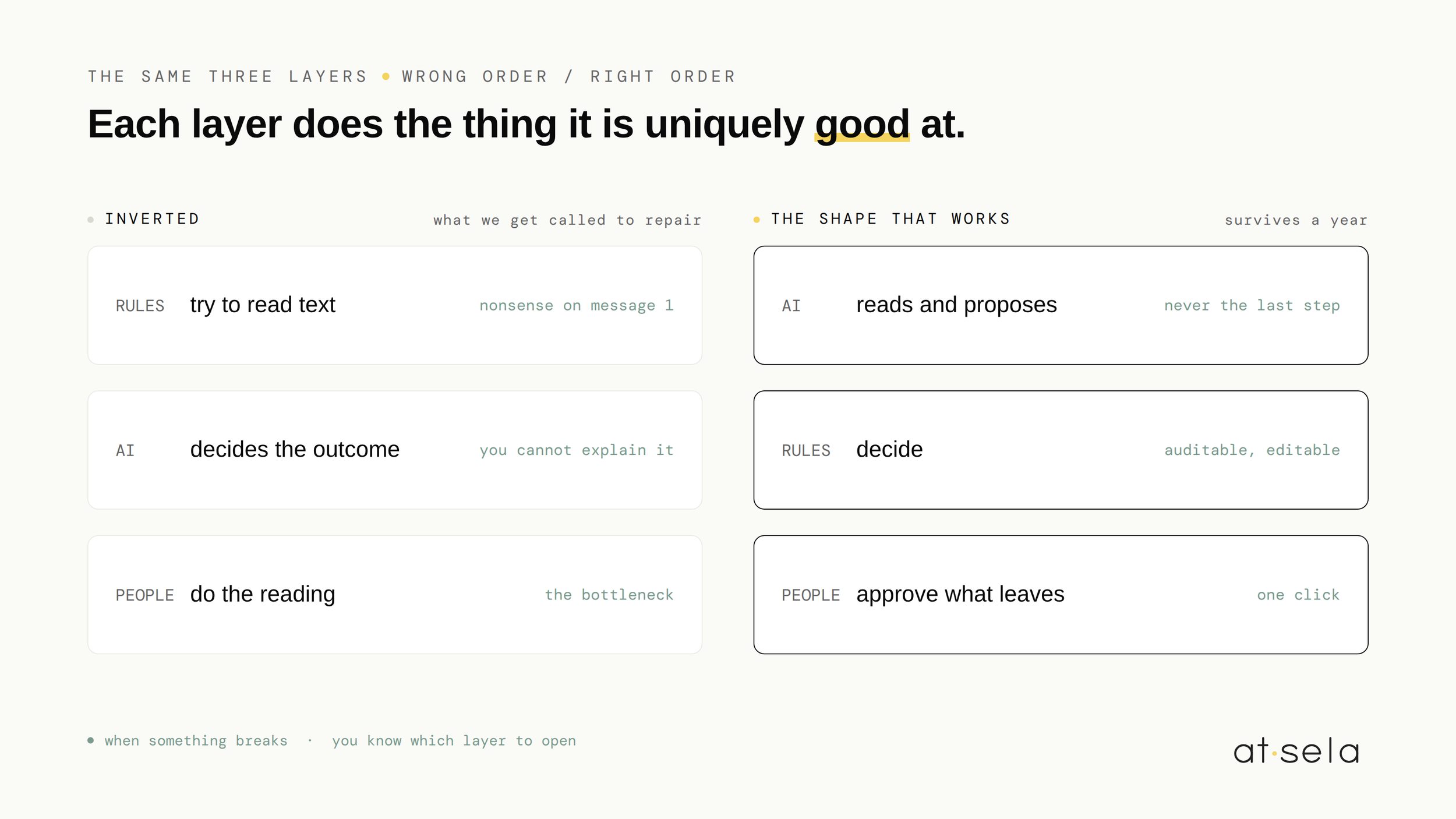
The systems that survive a year all look the same. AI reads and proposes. Rules decide. A person approves anything that leaves the building. Each layer does the thing it is uniquely good at, and when something breaks you know which layer to open.
Invert any of the three and you get the failures we are asked to repair. Rules trying to read text produce nonsense on the first message that does not match the keyword. Models deciding outcomes produce something you cannot explain. Humans doing the reading produce a bottleneck.
05What to do with this
Take whatever AI project is currently on your list and ask the question from section one. Could a rule do this? If the honest answer is yes, you have just saved yourself a build and a maintenance burden. If the answer is no because the input is messy human text, you have a good candidate.
And if you are not sure which of your tasks deserve any automation at all, the arithmetic takes ten minutes, and it is in the 10-minute self-audit. The way we work starts there too: we would rather tell you on a free call that something is not worth building than sell you the build.
Common questions, honest answers.
When should you not use AI +
When the task has one correct answer, like arithmetic. When you would have to justify the outcome to a client. When the underlying data disagrees with itself. When the task happens twice a year. And when nobody reviews the result before it reaches someone outside your company. In those five cases a rule, a formula or a person is cheaper and safer.
Is AI better than rules for automation +
Neither is better, they do different jobs. A rule is exact, repeatable and explainable, so it should handle anything you might have to justify. A model reads messy human text, which no rule can do. The test before adding AI to anything: could a rule do this? If yes, use the rule.
What happens if AI gets it wrong in a workflow +
It depends entirely on whether the model was allowed to decide or only to propose. If it drafts and a person approves, a mistake costs seconds. If it acts alone, a mistake reaches a client, and one wrong promise sent automatically can cost more than a year of saved time. That is why anything leaving the building keeps a human on it.
Curious if we can help
Book your free 30-minute AI scan. We'll map where your team actually loses time, and tell you honestly what's worth automating. And what isn't.
FREE AI SCAN