
When is a business ready to automate?
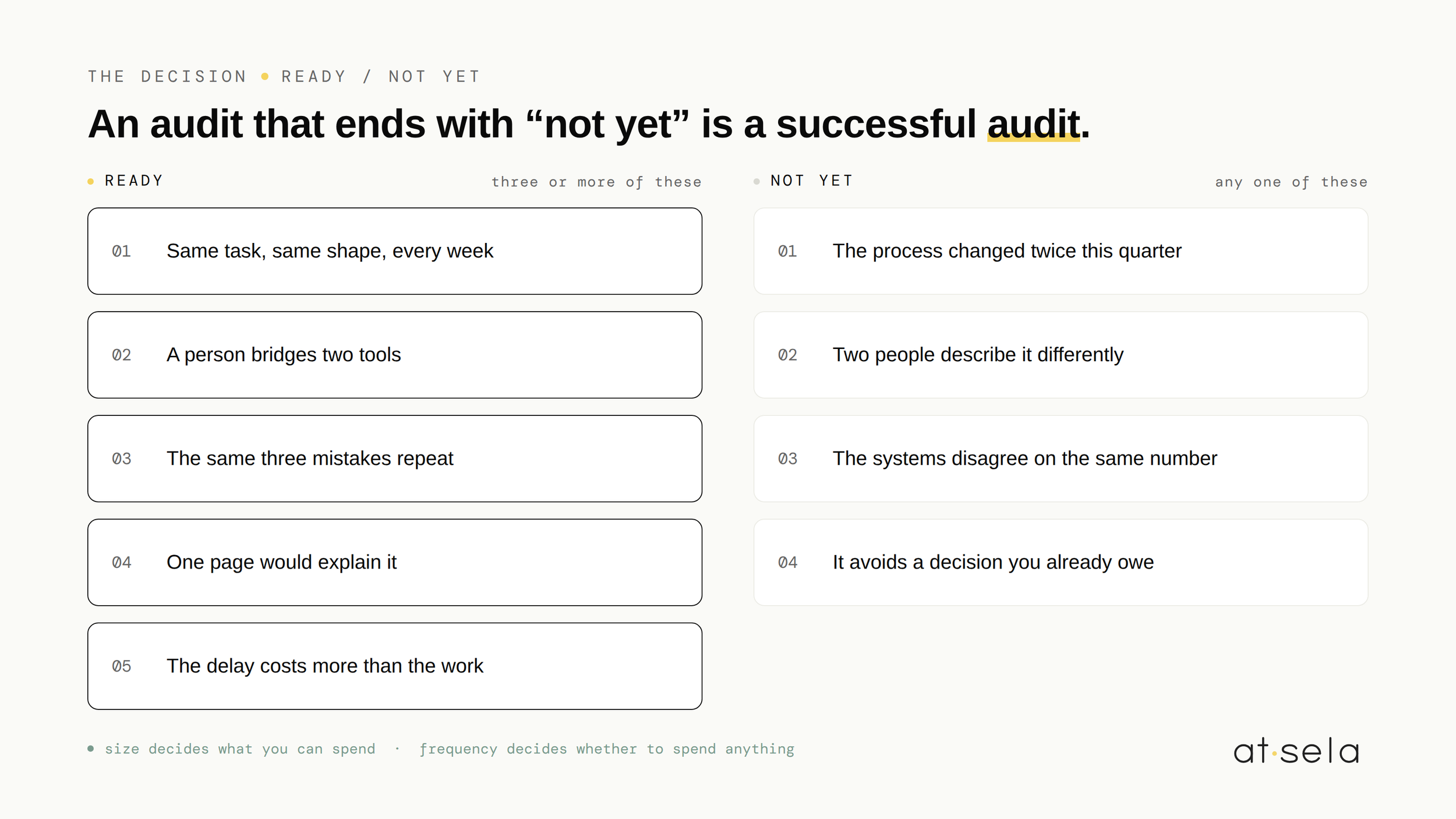
You are ready when the same task comes back on a schedule and always in the same shape, when a person is acting as the bridge between two tools, when the mistakes are always the same three, when you could describe the task to a new hire on one page, and when the delay is a bigger problem than the work itself. Five signs. You do not need all five, but you need more than one.
Notice what is not on that list. Company size, budget, and how modern your tools are. None of the three predicts whether automation will work, and all three are what most people use to decide.
01The five signs, in the order that matters
Not just frequent. The same steps in the same order, with the same kind of input. A task that happens daily but differently every time is repetition without stability, and stability is the part that matters.
Someone reads a value in one system and types it into another. This is the single clearest signal there is, because the person is doing work that has no judgment in it at all. They are being a connector.
A missing reference, a wrong date format, a field nobody filled. Errors that repeat are errors a rule can catch. Errors that are always different usually mean the process itself is not settled.
If you can write it down completely, a machine can follow it. If explaining it takes a conversation and three exceptions, it is not ready. Writing that page is the real test, and it is free.
The task takes minutes but happens two days late, and the two days are what costs you. An invoice reminder, a status update, a handover. Automation is often worth more for when it happens than for the time it saves.
02Sign two is the one to trust first
If you only look at one, look at whether someone is manually carrying data between two systems. It is visible, it is measurable, and it never involves judgment, which means automating it removes no thinking from the company. It is also the cheapest thing to build and the easiest to verify, because you can check the two systems agree.
Everything else on the list is a matter of degree. This one is binary. Either a human is retyping something a machine could move, or they are not.
03Why "we are too small" is usually the wrong test
Not how many people you are. A company of four with a task that runs forty times a month has a stronger case than a company of forty with a task that runs twice. Size decides how much you can spend. Frequency decides whether it is worth spending anything.
Small companies are often the better case, because there is nobody spare. A missing person on a Tuesday stops the invoicing. That fragility is exactly what a boring, well-documented automation fixes, and it does not require anyone to change how they work.
04Four signs you are not ready
- The process changed twice this quarter and will change again
- Two people describe the current process differently
- Your systems hold different versions of the same client or the same number
- You are automating to avoid a decision you already know you need to make
The last one is the expensive one and the least discussed. Automating around a tool nobody likes, a pricing model that creates the exceptions, or a hire you keep postponing gives you a faster version of a problem you have not solved. It also makes the real decision harder, because now there is a system built on top of it.
The third one deserves a mention too. Building on data that disagrees with itself propagates the disagreement, quickly and confidently, which is one of the cases we listed in when AI is the wrong tool for the job.
05What to do with this
Take the task you were already thinking about and count the signs. If you find one, it is probably not yet. If you find three or more, it is worth an hour of proper thinking, and the arithmetic that tells you whether it is worth building takes ten minutes and is in the 10-minute self-audit.
And if the honest answer is that you are not ready, that is a result, not a failure. An audit that ends with "not yet" saved you a build, a maintenance burden and a system you would have had to unpick later. We say it on the first call when it applies, and it is part of how we work.
Common questions, honest answers.
When is a business ready to automate +
When a task comes back on a schedule and always in the same shape, when a person is manually carrying data between two tools, when the mistakes are always the same few, when the task could be explained to a new hire on one page, and when the delay costs more than the work itself. You do not need all five signs, but one alone is rarely enough.
Is my company too small to automate +
Size is the wrong question. Frequency is the right one. A company of four with a task that runs forty times a month has a stronger case than a company of forty with a task that runs twice. Small companies are often better candidates, because there is nobody spare when one person is away.
When should you wait before automating +
When the process keeps changing, when two people describe it differently, when your systems hold different versions of the same data, or when you are automating to avoid a decision you already know you need to make. The last one is the most expensive: you end up with a faster version of an unsolved problem, and a system built on top of it.
Curious if we can help
Book your free 30-minute AI scan. We'll map where your team actually loses time, and tell you honestly what's worth automating. And what isn't.
FREE AI SCAN